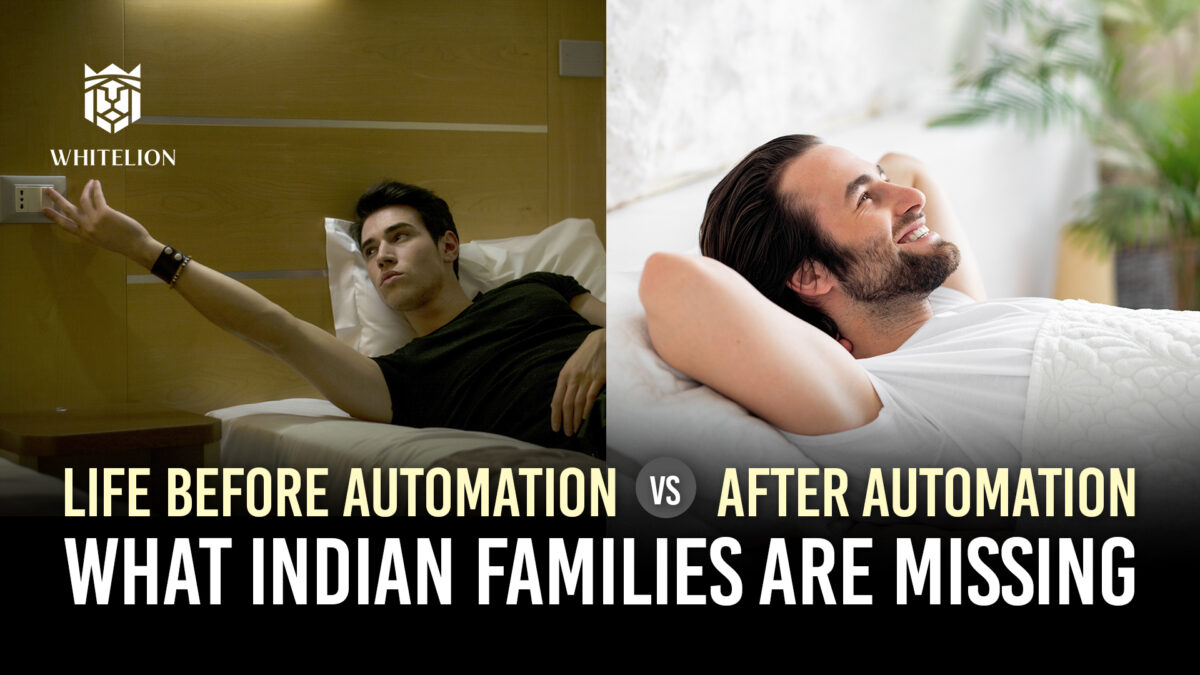

Life Before Automation vs After Automation: What Indian Families Are Missing
In your home, every day starts the same way.
An alarm rings. Someone switches on the lights. Someone else forgets to turn off the geyser. Curtains stay closed longer than they should. The fan speed is either too fast or too slow. Before the day has even begun, there’s already noise, movement, and stress.
This is life before home automation in most Indian households completely manual, completely dependent on memory, and surprisingly exhausting.
Now imagine the same home behaving differently.
Not smarter in a flashy way, but smarter in a supportive way. This is where the real difference between life before automation and life after automation begins.
Life Before Automation: A Home That Needs Constant Attention
In a your home, everything depends on people remembering things. Lights need to be switched off manually. Fans run even when no one is in the room. Before leaving home, you walk from room to room checking switches, only to lock the door and immediately wonder if you missed something.
This routine repeats every single day. The home works, but it demands effort. Mental effort. Evenings aren’t easier. Kids need bright lights to study. Parents want softer lighting to relax. Elders need comfort and safety while moving around at night. Without automation, this balance requires constant switching, adjusting, and reminding.
And then there are power cuts. When electricity goes off and comes back, lights turn on randomly, fans restart at full speed, and everything feels disturbed again. Comfort resets. Calm disappears.
This is not a problem of discipline. It’s a problem of systems.
Life After Automation: A Home That Starts Working for You
Now think about your home after smart automation.
In the morning, lights turn on gently instead of suddenly. Curtains open on their own. The fan adjusts automatically. You don’t rush the house eases you into the day. This is what smart home automation in India looks like when it’s designed for real life.
When you leave home, there’s no second guessing. One tap on your panel or phone activates an “Away Mode.” Lights switch off. Fans and appliances shut down. You walk out knowing your home is taken care of.
In the evening, the house adjusts again. Study lights turn on when children sit down. Warm lighting sets the mood for parents. Soft night lights guide elders safely at night. No one argues about switches. No one runs around adjusting settings. The home adapts quietly.
This is life after automation not dramatic, just easier.
Why Features Like Memory Recall Matter in Indian Homes
Power cuts are still part of daily life in many Indian cities and towns. This is why automation needs to be practical, not just smart.
With Memory Recall, Whitelion touch panels remember the last setting even after a power cut. When electricity comes back, lights and devices return to the same state as before. If a light was off, it stays off. If a fan was running slowly, it resumes at the same speed.
Life doesn’t restart just because the power did.
And that one detail alone removes a lot of daily irritation from Indian homes.
What Indian Families Are Actually Missing
Most families think home automation is about luxury. In reality, it’s about reducing everyday friction. Without automation, you lose time every day. You carry mental load. You worry about electricity bills. You remind people repeatedly. You adjust the same switches again and again.
What you’re missing is not technology. You’re missing peace of mind.
Smart home automation gives you saved time, lower energy waste, safer movement for elders, better routines for children, and a calmer home environment overall. That’s why brands like Whitelion focus on making automation feel invisible not complicated, not flashy, just naturally helpful.
Designed for Real Indian Routines
Indian homes are not silent, empty spaces. They are full of people, helpers, guests, children, elders, and daily movement. Automation here needs to work with these realities.
Whitelion’s smart home solutions are built keeping Indian lifestyles in mind frequent power cuts, joint families, daily helpers, festivals, guests, and changing routines. Whether it’s the Posh Series, Quartz Series, or Air Series, automation can be added step by step, without changing how your home feels. This makes smart living practical, not overwhelming.
The Real Difference Automation Makes
Before automation, your home depends on you for everything.
After automation, your home starts supporting you.
Before automation, comfort breaks easily.
After automation, comfort stays consistent.
Before automation, you manage your home.
After automation, your home manages the routine.
That is the real shift Indian families are missing and once experienced, it’s impossible to go back.
Final Thought
Tonight, before sleeping, you’ll probably walk around switching off lights, slowing fans, and reminding someone one last time. Now imagine a home that does all of this for you.
That’s not luxury.
That’s smart living.
And that’s exactly what Whitelion is bringing to Indian homes.

ph dream 55
Ph Dream 55, I keep hearing about this! Is it worth the hype? Hmm, might just try it out tonight. Hopefully my dreams come true at ph dream 55 .
cc666
Saw cc666 mentioned on a forum. Signed up and tossed in a few bucks. Actually had a decent run! Not saying it’s gonna make you rich but it’s a fun way to kill some time. cc666
jlph app
Downloaded the jlph app recently. It’s pretty slick! Runs well on my phone and I like the interface. Makes playing on the go super easy. jlph app
321gobetlogin
Heard some buzz about 321gobetlogin, thinking of giving it a shot. Anyone had any luck there? Curious to see what the fuss is all about! Give 321gobetlogin a look see.
3831bet
3831bet seems pretty legit. Been messing around on the site and it’s definitely delivering some decent experiences. Check out 3831bet!
39jllogin
Alright, alright, alright… anyone else using 39jllogin? Just signed up. I am willing to see this through, give a trial. Do a quick look thanks to this link: 39jllogin
jaya77login
Finally found a platform that doesn’t lag during peak hours. The login process is quick and hassle free. Highly recommend giving jaya77login a shot if you are looking for reliability.
dragon212slot
Just hit a decent jackpot today! The slots here are fair and the graphics are amazing. Definitely give dragon212slot a try if you enjoy spinning.
phjilibit
Love the variety of games here. I had a great run last night and the customer support was very helpful with my deposit. Check out phjilibit
juan365downloadapk
I was looking for a stable place to get the app and this worked perfectly. The installation was smooth and everything runs great on my device. Check it out at juan365downloadapk
pkbit555
The graphics are sharp and the gameplay is lag free. It is rare to find a site that runs this smoothly on mobile. Check out pkbit555 for yourself.
x777eelogin
I’ve tried a few sites lately but this one is definitely the smoothest. The login is fast and I love the game variety. Check out x777eelogin for a great experience!
pkm555
The loading speed is amazing and the graphics are top notch. I had a lucky streak yesterday thanks to pkm555.
bdqq7777
Honestly one of the most intuitive sites I have encountered. I really enjoy the overall experience on bdqq7777.
jljl8login
The login process is seamless and the site loads quickly even on my mobile data. Everything feels very intuitive. I suggest using jljl8login for a hassle free session.
bosdolarslot
Finally found a slot site that actually pays out! The bonuses here are insane and the graphics are top notch. Just check out bosdolarslot if you want some real action.