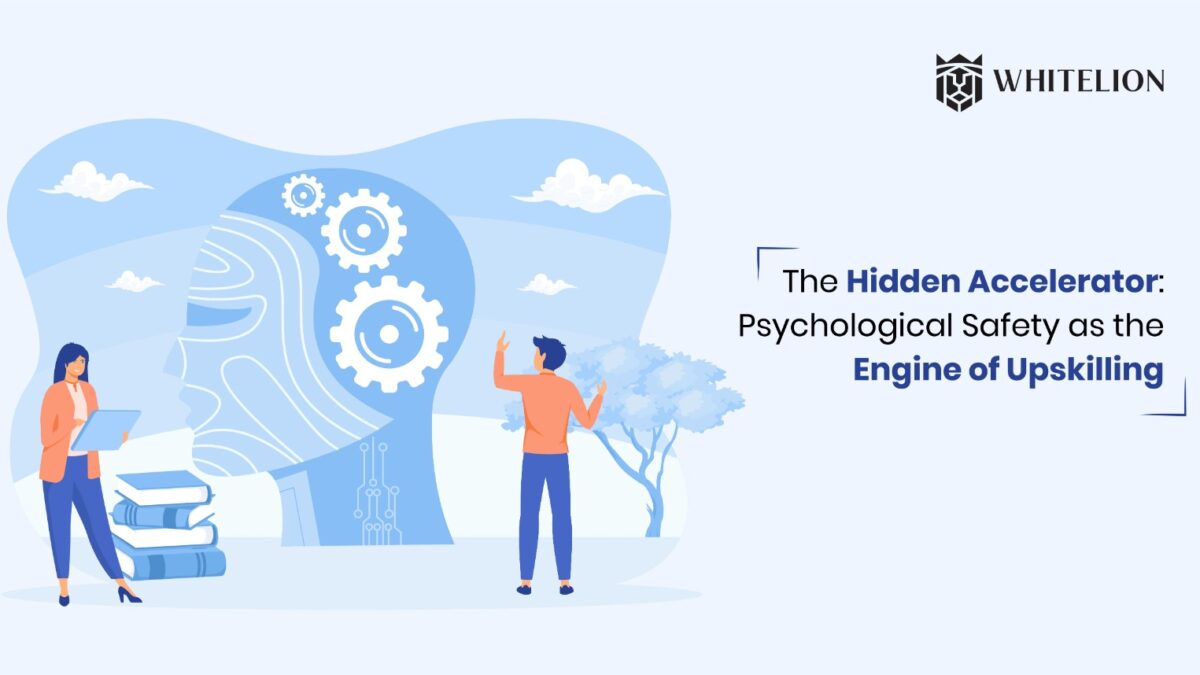

Psychological Safety: The Missing Link in Successful Upskilling
As HR leaders, we spend millions on learning platforms, certifications, and training content. But here’s the truth: these investments only pay off if employees feel safe enough to actually apply what they learn.
That safety has a name — psychological safety. It’s the shared belief that people can ask questions, admit mistakes, or share half-baked ideas without fear of judgment. And in the context of upskilling, it’s the difference between a workforce that passively “consumes training” and one that actively experiments, applies, and grows at speed.
Why Psychological Safety Powers Upskilling
- Learning requires vulnerability
People must acknowledge gaps before they can grow. Without safety, they hide weaknesses instead of fixing them. - Experimentation is messy
Mistakes are part of learning. In a safe environment, errors become data points — not reasons for punishment. - Knowledge flows through trust
Employees freely share tips, tools, and playbooks only when they know they won’t be judged for not knowing.
In short: skills are the fuel, but psychological safety is the engine.
Signs Your Organization Lacks Safety for Learning
- Training completion is high, but skill application is low.
- Meetings are silent — few questions, no requests for help.
- Employees learn “after hours” to avoid looking unprepared.
- Managers praise outcomes but ignore efforts and experiments.
How HR Can Build Psychological Safety into Learning
Here’s a practical blueprint HR leaders can apply:
1. Redesign the Learning Narrative
- Focus on progress, not perfection.
- Use prompts like: What did you try? What surprised you?
- Normalize sharing drafts, prototypes, and half-done ideas.
2. Build Manager Muscle for Safety
- Train managers to ask curiosity-first questions.
- Encourage them to share their own learning journeys.
- Praise the process, not just the outcome.
3. Turn Mistakes Into Learning Assets
- Run blameless “Learn Reviews.”
- Document lessons in a simple “Learning Ledger.”
- Recognize teams whose lessons get reused.
4. Make Peer Learning Default
- Host monthly “Skill Circles.”
- Assign “Learning Catalysts” in each team.
- Set clear norms for safe and quick Q&A.
5. De-risk Real Application with Pilots
- Pair new skills with safe sandbox projects.
- Define scope, success criteria, and exit ramps.
- Share outcomes across teams.
6. Align Incentives with Learning Velocity
- Recognize skill application, not just delivery.
- Celebrate useful failures and shared playbooks.
- Track internal mobility as a success metric.
Real-World Examples
- Engineering: A junior developer’s POC isn’t shipped but shortens evaluation cycles for the whole team.
- Sales: Teams role-play new discovery techniques, with managers rewarding curiosity, not just close rates.
- HR: Recruiters test AI-assisted screening; early mistakes create a playbook that later saves 30% time.
Metrics That Matter
Instead of just tracking course completions, measure:
- Application rate (new skill used within 30 days)
- Learning velocity (training → real work)
- Reuse rate (how often playbooks are adopted)
- Safety signals (pulse surveys on “I can ask for help”)
- Internal mobility tied to new skills
Final Word: The HR Leader’s Role
HR is in the best position to hardwire safety into culture by:
- Embedding safe learning behaviors into leadership competencies
- Updating performance reviews to reward knowledge-sharing
- Equipping managers with coaching scripts and toolkits
- Making “Learning Reviews” and “Skill Circles” part of daily rhythms
When employees feel safe, they experiment, ask better questions, and share lessons openly. Psychological safety doesn’t just make people feel better — it makes organizations learn better.
If upskilling is your strategy, psychological safety is your multiplier. Design for both.

jljl77 legit
Was wondering if jljl77 was legit. I did some digging and seems okay so far. I mean, it’s gambling, so manage your bankroll but I haven’t seen anything shady. jljl77 legit
casino plus app
The casino plus app is my go-to when I’m bored. Easy to use and the games are decent. Just remember to play responsibly, folks! casino plus app
philucky777
Philucky777 could be your lucky charm! I’ve had some decent spins here and there. Give it a whirl: philucky777
80jili.com app download
Downloaded the 80jili.com app. Pretty smooth experience so far. Much easier to play on the go. Grab yours: 80jili.com app download
awin68 awin168.org
I found Awin68 awin168.org official channels links for Awin platform. Here is the link: awin68 awin168.org
phjljl99
Very reliable site with a great community of players. I feel safe depositing my money here because the withdrawals are seamless. Trust phjljl99.
3777bdtapk
Installation was a breeze and the app works perfectly. No annoying bugs or crashes during my sessions. Thanks to 3777bdtapk for the great service.
evoplaycasino
The graphics and game variety here are just on another level. It feels like a premium casino experience. Visit evoplaycasino today!
24merryph
24merryph is allright! Good selection of games and it’s easy to register. All in all a good experience with 24merryph!
br52betwin
Really impressed with the game variety. Everything loads quickly and the graphics are top notch. br52betwin is definitely my new go-to spot.
idmpocash
I’ve tried a few platforms lately, but this one really stands out for its fast payouts. Definitely worth a try if you want a smooth experience. Check it out at idmpocash
koin138login
Finally a site where the login process is actually straightforward and doesn’t lag. It makes getting into the action so much easier. Love the efficiency here. koin138login