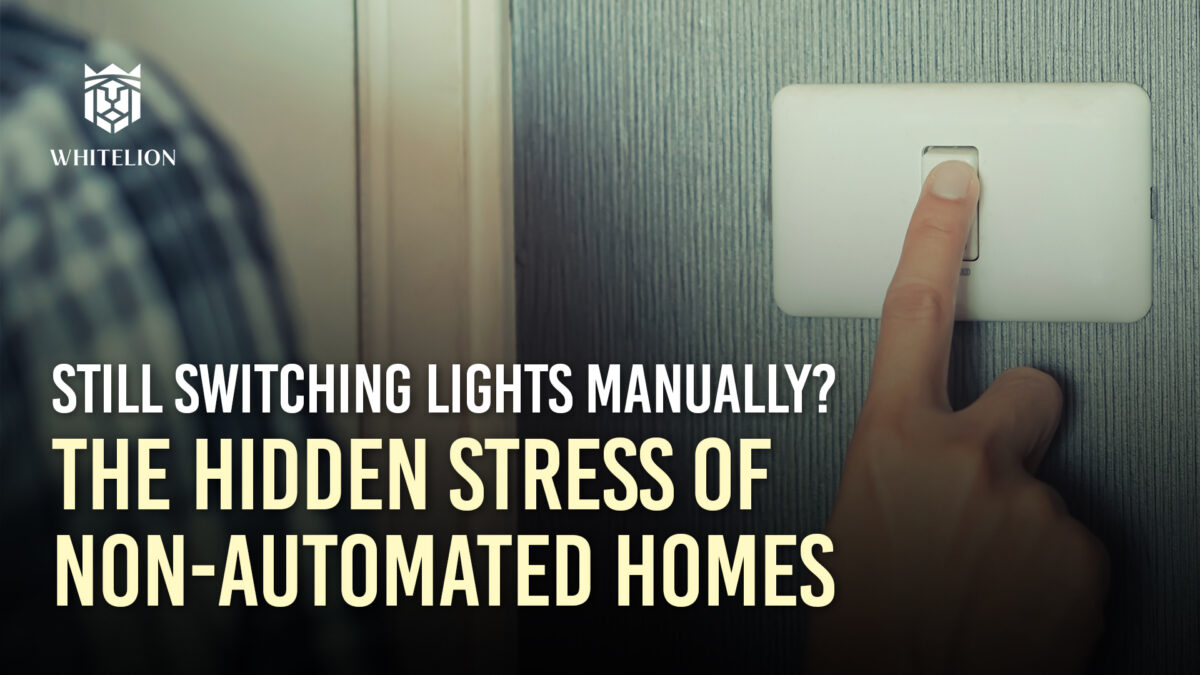

Still Switching Lights Manually? The Hidden Stress of Non-Automated Homes
Be honest for a second. In your home, how many times a day do you switch lights on and off? Not because you want to but because you have to.
You get up to turn off the bedroom light. You walk back from the sofa to switch off the fan. You reach the door, stop, and turn around because maybe the kitchen light is still on. This feels normal. So normal that we don’t question it. But this is exactly where the hidden stress of non-automated homes begins.
The Daily Switch Routine You’ve Accepted as “Normal”
In your home, switching lights isn’t a task. It’s a routine.
In the morning, you turn on lights, turn off the geyser, and adjust the fan. In the afternoon, you switch off rooms no one is using. In the evening, the lights feel too bright, then too dim so you adjust again. At night, you do one last round before bed lights, fans, double-checks.
Each action takes just a few seconds. But together, they quietly add up not just in time, but in mental effort. By the end of the day, you feel tired. And you don’t even know why.
Why Manual Homes Create Mental Noise
The biggest stress isn’t walking. It’s what stays in your head.
While working, a thought suddenly appears:
“Light bandh ki thi kya?”
While travelling:
“Fan reh toh nahi gaya?”
While trying to relax:
“Kal subah geyser ka dhyaan rakhna.”
Your home follows you everywhere not physically, but mentally. Homes without automation don’t just need effort. They need constant remembering. And remembering all the time is exhausting.
Why This Feels Worse in Indian Homes
Indian homes are never still. Kids running around. Parents adjusting things. Elders moving at night. Helpers coming and going. Guests arriving unannounced. Power cuts happening unexpectedly. Nothing stays fixed.
So switches are used more. Lights are adjusted more. Fans are changed more. Manual control becomes constant control. And constant control slowly becomes stress.
What Changes When a Home Becomes Smart
When smart automation enters a home, something very subtle changes. You stop thinking about switches. With Whitelion Home Automation, lights don’t wait for instructions every time they follow routines. Fans don’t need constant tweaking they respond automatically. Scenes replace multiple switches. Leaving home becomes one action, not a checklist.
Your home starts handling the small things on its own. And when small things disappear from your daily to-do list, life feels lighter.
The Relief of a Home That Remembers
One of the most frustrating moments in Indian homes is after a power cut. Lights turn on randomly. Fans start at full speed. Everything feels disturbed.
Whitelion solves this with Memory Recall. Your home remembers how things were before the power went. When electricity returns, lights and fans come back exactly the same way. No sudden brightness. No chaos. No resetting.
It’s a small detail but it removes a lot of daily irritation.
This Isn’t About Luxury. It’s About Relief.
Smart home automation isn’t about showing technology. It’s about fewer interruptions. Fewer reminders. Fewer unnecessary movements. Fewer “did I switch it off?” moments.
That’s why Whitelion doesn’t focus on futuristic promises. It focuses on easier everyday living, designed for Indian homes.
Final Thought
Tonight, before sleeping, you’ll probably do one last round switching off lights, adjusting fans, checking rooms.
Now imagine not having to. That’s not about being smart. That’s about being at peace.
And that’s exactly what Whitelion Home Automation is built to deliver homes that don’t demand attention, they give it back.

mbetapp
Yo, the mbetapp is pretty good. Easy to use on my phone, so I can easily place my bets whenever and wherever I am. Try downloading their app, you might like it.
q888bet
Heard some good things about q888bet and decided to check it out myself. Not disappointed. The experience is pretty good all around. Check it out q888bet!
soso66
Been using soso66 for a bit and I’m actually liking it. Everything’s smooth and easy to understand. I recommend you try to see if it’s for you soso66!
idturbo88
The speed of the site is amazing, just like the name suggests. No glitches and the graphics are sharp. I am really enjoying my time at idturbo88.
yasspin
I love how quick the withdrawals are. No more waiting for days to get my winnings. yasspin is definitely a winner in my book.
vnh13game
The variety of games available is impressive. I really appreciate how stable the platform is even during peak hours. Check out vnh13game if you want a reliable place to play.
phbigwinph
Just had a massive win last night! The thrill on this site is unmatched and the graphics are top notch. phbigwinph is definitely my new favorite spot.